
Not too long now...
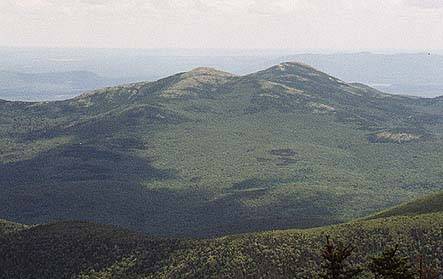 Last December, President Bush quietly signed into law the New England Wilderness Act, which augments several existing wilderness areas and creates three entirely new ones—74,000 new acres of wilderness in all. Hikers and other wilderness enthusiasts in the northeast should thank their lucky stars. The bill is an aberration, a consequence of rare support from Congressional Republicans, whose championing of environmental issues has been virtually unheard of for the past six years.
  These New Hampshire Republicans, though fiscally conservative, take a moderate approach to environmental issues. Gregg and Bradley, in particular, have a real affinity for the outdoors—Bradley is a member of the Appalachian Mountain Club’s New Hampshire 4000 Footer Club, and all members are strongly supported by hunting and fishing groups. Their stance was good politics, as well. With the electorate clearly leaning Democratic last fall, the New England Wilderness Act offered a chance for distinction from President Bush.
  not taken as proof of the natural world’s health or an excuse for development. Rather, they are a repository of tranquility where we can acknowledge humanity’s complicated relationship with nature and, I hope, resolve to do better.
 This past weekend, Emily Hoffer, my Mizpah croomate last fall, and I skied Cannon Mountain. Despite its vertical drop, Cannon is smaller than the best-known New England resorts and has a justified reputation for iciness. Most patrons are locals, including, most famously, Bode Miller.
 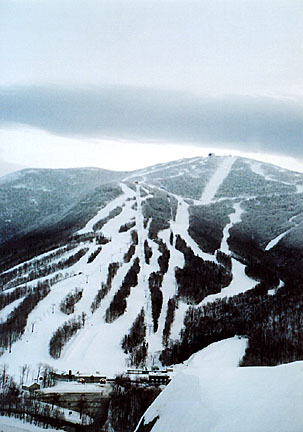 Cannon was among the first mountains colonized by early American ski pioneers. They cut the Taft Slalom Trail, the country’s first racing trail, in 1933. In 1938, the resort built an aerial tramway leading to the summit (it was replaced in 1980), which gives the resort a slightly European flavor. Operated by the state, Cannon is devoid of slopeside condos and non-ski related activities.
 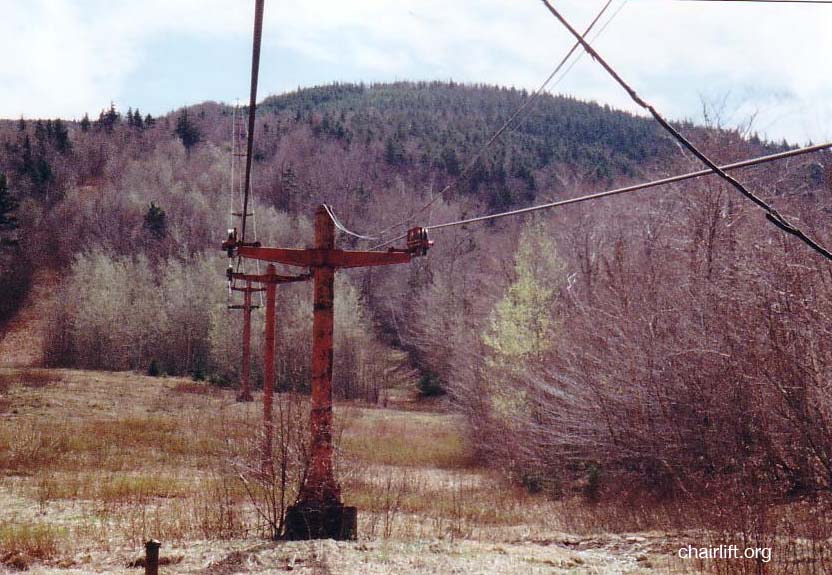 anyway. The old lift towers, still holding up a rusty cable, are an eerie reminder of the resort’s past. Like anything abandoned by humans, the old trail complex has an aura of mystery and loneliness, especially as the afternoon shadows grow longer.
 in 1945, opened the Mittersill resort, then just a small T-bar known as the “alpine lift.” The base hotel, however, was striking. Complete with long overhanging expanses of wood on the upper stories and decorative shields, the lodge’s design was loosely based on the Baron’s Schloss Mittersill in Austria. Indeed, the Baron made a post-World War II visit in 1950 to examine his property, where despite damage from research by a Nazi doctor trying to justify Nazi ideology of racial superiority, he restored his club. Today, Schloss Mittersill is a Christian study center.
 With four feet of fresh powder falling last week, it did not take much for me to accede to a friend’s invitation to Mad River Glen. Known for its challenging terrain, minimalist approach to snowmaking, and single chair, Mad River—“Ski it if you can,” blares their bumper sticker—is a simple and traditional resort. It’s the kind of place where ownership is cooperative, snowboarders aren’t allowed, and most people in the lift lines are old friends. Access to one of the few slopeside condos is not something to be taken lightly.
 touring gear is the norm—this system combines the best aspects of telemarking and alpine skiing. With AT bindings, the heel releases for skinning uphill, but it also clips in for easier turns on steep downhills. The advantages over telemark gear are considerable: AT equipment tends to be lighter, safer in a fall (as Andrew McLean of telemarktips.com points out, AT skis have a mechanical release system, whereas the telly release system is biological—your ACL breaking), more efficient on the uphill and more controlled on the downhill, has boots better suited to crampons, and is easier to put on (step-in vs. bend down and attach). What AT skis lack in countercultural appeal, they make up for in functionality.
 speaks of temperatures “warming up to 5 degrees.”
  becomes clear they are a mixed group of family and friends. Drawn by the challenge and camaraderie of a winter outing, they make an annual outing to the huts. The off-season price is affordable, too—at $28 for non-AMC members, an individual saves almost $60 on full-service prices.
  personality, because some people do get lonely” (a caretaker at nearby Carter Notch Hut recently quit because the job was so solitary). When the radio squawks—Joanne, the caretaker at Zealand Falls Hut, is calling the AMC’s Construction Crew, presumably because something at her hut isn’t working—Bajo jumps up and runs to the radio to listen. “My program’s on!” she yells, and then comes back disappointed when no one responds to the radio call. “There’s enough work up here to occupy your time…at night, I listen to NPR, so it’s not like I don’t hear people’s voices for a week.”
  thinking about another two months of spring caretaking. By August, she will have spent an entire year working in the backcountry. Born a flatlander, she prefers the rugged terrain of New Hampshire and Vermont and has plans to stay. After caretaking, she can survive anything. “It’s an opportunity to live a sparser life than in the frontcountry,” she says, and settles down for a late morning nap, to be followed by a couple of laps around the lake in the afternoon.
 The trouble with modern art museums is that the buildings tend to overshadow the art within. This is the case with the ICA/Boston, an arresting new building on the Fan Pier just east of downtown. Its situation is magnificent, and it stands as a major milestone in the transformation of Boston’s waterfront.
  indulgent,” “contrived,” and “kitschy” are more accurate.
  A wiser plan would have converted the land into prime building space, easing the pressure on the already cramped real estate market. Instead, development is spilling across Fort Point Channel and onto the South Boston waterfront. Long home to docks, fish processing plants and distribution centers, vast parking lots, and the odd upscale seafood restaurant (Anthony’s on Pier 4, more recently the Barking Crab), the area is no stranger to redevelopment; the World Trade Center has spawned a colony of sleek hotels to the east, and the new Moakley Federal Courthouse is a massive castle-like edifice on the edge of Fort Point Channel. The old brown turntable bridge has been replaced by a sleeker, less distinctive span.
  Fallon, is planning a new luxury hotel and residential building adjacent to the ICA, to be followed by various further office and residential buildings depending on demand. While the buildings are hardly skyscrapers—mostly within the 150 to 225 ft. range—their size will make it difficult for them to create the neighborhood feel of the North End or Back Bay.
 The building is intriguing and from some angles, attractive. Its cantilevered fourth floor is at its best when viewed from the east or west; unfortunately, it presents itself as a box to the south, which is the angle from which most people will see it. Inside, the lobby and restaurant occupy most of the first floor, while the second and third are taken up by a theater. The fourth floor is reserved for art, and thanks to the cantilevered design, it is much bigger than one might imagine.
  Two features stand out—the mediatheque, basically a downward-angling computer lab looking meditatively into the blue harbor, and a long observation corridor, which offers a stunning view of the harbor and the East Boston Shore through an entirely glass wall. Finally, the future boardwalk lining the waterfront is another excellent idea.
  What’s unique architecturally about the ICA in Boston, however, is not necessarily distinctive on the international stage. Cantilevered roofs are currently in vogue among designers of cultural buildings—note Henning Larson’s new Operaen (Copenhagen Opera House) or Vienna’s refurbished Albertaina. The ICA building and future developments on Fan Pier will make a striking contrast to what Ouroussoff calls “Boston’s architectural aspirations: brick,” but will they be livable? Does Boston want to distinguish itself architecturally by emulating successful features of world cities or by emphasizing its own quirks? Is it possible to construct a vibrant urban neighborhood from glass and steel, or is Fan Pier destined to become an enclave of the wealthy and isolated as well as a tourist destination, meanwhile depriving Boston of another piece of its maritime past?
 Saturday morning saw me quit
 What to do in the meantime? I learned on my last day up at Mizpah this fall how easy it is to lean on those who can afford it. The Mount Washington Hotel, home to the Bretton Woods Conference where ideas for the IMF and World bank were hatched, is the poshest resort up north. Blessed with a superb location—the Hotel faces the main ridge of the Presidentials, dominated by
The irony of a place like the Mt. Washington Hotel is that most guests are social climbers. They aren’t the confident, suave people one imagines luxuriating in a place like this; rather, they go there to impress themselves and their friends. It’s not unusual to hear a strong New Hampshuh accent on the verandah, or to see a mom shushing her kids in the front hall. The jetset may have frequented the Mt. Washington Hotel back in the 40s and 50s, but now they’re going to Vail or the Carribean in the winter.
So if you can look a doorman in the eye and keep the cuss words to a minimum, it’s not too hard to blend in. After all, the staff isn’t going to challenge you—you might be the rough around the edges face of new money, for all they know.
Enter via the 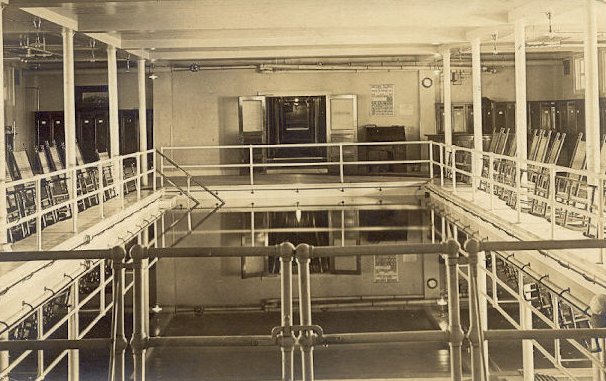 side door closest to the parking lot (that is, unless you choose valet): the pool is all the way at the end of the corridor, about a quarter of a mile away. The hotel provides towels—all you need is a swimsuit, or in my case, a pair of boxers. In addition to the Jacuzzi, there are two pools, an indoors and a heated outdoors. I prefer the latter—the view of the Presidentials is tremendous, and the steam rising off the surface in cold weather (it was about 10 degrees out on Monday) is both beautiful and conducive to privacy.
If you feel like mingling, head upstairs after your soak and grab a paper and a cocktail in the main hall. The late afternoon alpenglow on the Presidentials is particularly fine. And as you head at the door, a snappy farewell is a nice parting shot—I find that “Ciao” seems t o elicit the most patronizing response from the doorman.
Luxury is a dangerous habit but a delightful treat.

